How many Google Ads belong in one ad group?

Table of contents
Two. Run two responsive search ads per ad group. Google caps you at three enabled, recommends at least two, and its own data shows the third adds little on top of the second. More than three is not an option the platform gives you.
The urge to add more ads comes from the wrong mental model. A budget buys a fixed number of impressions, so every extra ad divides those impressions between more candidates rather than creating new ones.
The three numbers behind the question
This question usually hides three separate ones, because ads, ad groups and campaigns all get called “ads” in conversation. Each has a different number.
Ads per ad group: two
Two enabled responsive search ads is the working answer. Google’s responsive search ads guide recommends at least two per ad group with Good or Excellent Ad Strength and a unique final URL for each. The hard ceiling, listed on Google’s account limits page, is three enabled RSAs per ad group.
Ad groups per campaign: three to seven
Each ad group should represent one search intent, so the count follows how many distinct things people search for within that campaign. Fewer than three usually means the campaign is too narrow to justify its own budget. More than about seven usually means you are looking at two campaigns.
The test is simple. Once you cannot write one ad that suits every keyword in the group, you have crossed the line.
Campaigns: as few as your budget supports
Campaigns are where budget is set, so every new campaign divides the money again. A typical Australian small business account needs one or two, not six.
Why two ads beats five
The platform stops you at three
Five enabled responsive search ads in one ad group is not possible. Three is the limit. The separate cap of 50 active ads per ad group applies to other text ad formats, not to RSAs.
Only enabled RSAs count toward the three. Paused ads do not use a slot, so pausing an old ad rather than deleting it keeps its performance history without costing you room for a new one.
That leaves a choice between one, two or three, and two wins in the large majority of ad groups.
The returns fall away fast
Google publishes its own figures on this in the About responsive search ads help page. Based on its internal data, advertisers who add a second RSA to an ad group see an average 6.6% increase in conversions at a similar cost per conversion. Adding a third brings a further 3.7% on average.
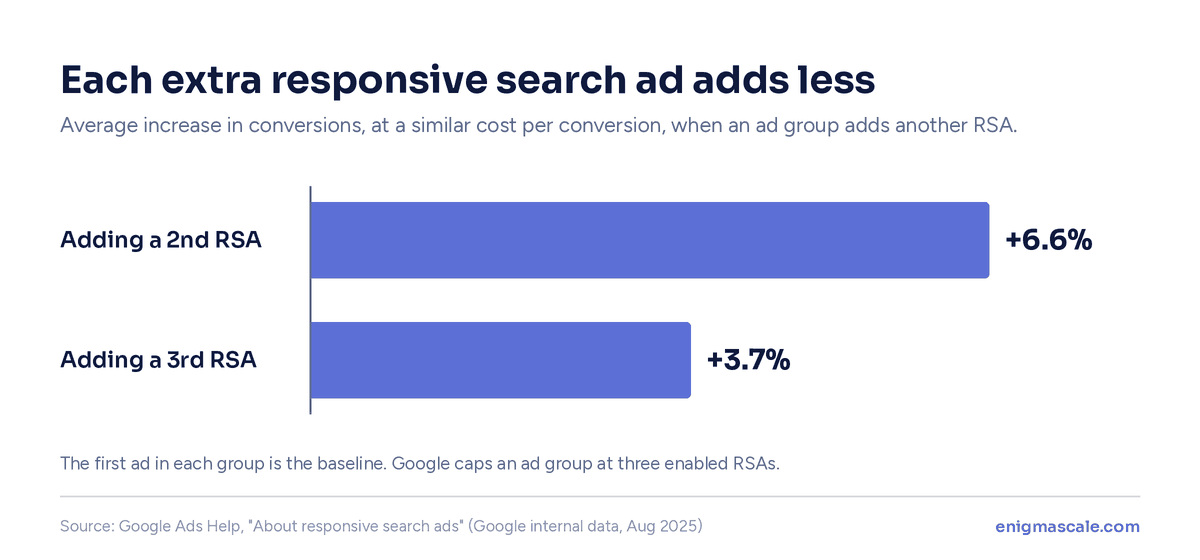
Treat those figures as a curve, not a reason to max out. The second ad earns its place comfortably. The third earns a little over half as much and adds another ad to write, monitor and refresh, which is why many accounts settle at two and spend the saved effort on the landing page instead.
The ad already tests itself
A responsive search ad accepts up to 15 headlines and 4 descriptions, and Google assembles them into combinations automatically. One RSA is already running dozens of variations.
That makes the headline list more important than the ad count. Supply 10 to 15 headlines and all 4 descriptions, each taking a distinct angle rather than rewording the same claim. Google’s RSA best practices say to add as many unique headlines and descriptions as you can, and short headline lists are a common reason Ad Strength sits below Good.
Stacking three RSAs on top of that does not triple the testing. It triples the number of things competing for the same impressions, so every combination takes three times longer to show a result. In a small account, that is the gap between knowing which ad works in six weeks and never finding out.
Performance Max works differently again. It has no ads in the search sense: you build asset groups, and Google assembles the ads from the headlines, descriptions, images and videos you supply.
How many campaigns your budget can support
Budget is set per campaign, not per account
This detail catches a lot of advertisers out. There is no single monthly figure for Google Ads. Each campaign gets an average daily budget, and the account spends whatever those campaigns add up to.
Six campaigns on AUD 3,000 a month means each one gets about AUD 16 a day. At Australian click prices, that is roughly four clicks. No campaign learns anything on four clicks a day.
The starving campaign problem
A campaign needs enough conversions to teach the bidding algorithm what a good customer looks like. Split too far and none of them reach that threshold, so every campaign stays stuck in learning.
An account with more campaigns than it has thousands of dollars in monthly budget very likely has too many. Consolidating is usually the fastest improvement available, and it is where most of our Google Ads account rebuilds start.
When splitting is worth it
Three reasons justify a new campaign: the budgets need controlling separately, the targeting covers different locations, or the campaign types differ. Anything else is a preference rather than a requirement, and preferences get expensive once there are six of them to maintain.
To make one service spend more, raise its budget inside the existing campaign rather than building it a new one. Check what management costs before adding complexity someone will have to look after.
How to get to the right numbers
Start with one ad, add the second after 30 days
Launch two ads on day one and neither has data, so there is nothing to tell them apart. Start with one strong responsive search ad and let it gather a month of impressions. Then add a second written to test a different angle, not reworded headlines.
An ad group producing fewer than about 50 clicks a month should stay on one ad. It will not gather enough data to separate two.
Give each ad its own destination where you can
Google’s recommendation includes a unique final URL for each responsive search ad, a reminder that ad testing and landing page testing are the same exercise. When every ad points at the same page, only half the funnel is being tested, and that is a web design gap rather than an advertising one.
Fix the ad group before adding ads
If one ad cannot represent an ad group well, the ad group is the problem, not the ad count. Groups carrying two intents need splitting, and that decision sits alongside how many keywords belong in each one.
Aim for Good Ad Strength, but do not chase Excellent
Ad Strength is a useful prompt to add headlines and unpin assets, and reaching Good is worth the effort. Google’s own Ad Strength help page says the rating does not determine whether an ad is eligible to serve, and it is not part of how the auction ranks ads. Grinding from Good to Excellent rarely changes performance. Our guide on whether Ad Strength is worth chasing goes further.
Five campaigns running on a budget built for two is the first thing to fix. Our pay per click management work usually starts by consolidating rather than building.
Vignesh runs paid media, social and design at Enigma Scale. He has managed spend across every major ad platform and rebuilt the sites those clicks land on, which is usually where the real problem turns out to be.
More from Vignesh →